Showing posts with label PTC6. Show all posts

Sunday, September 4, 2016

Coaching

A coach...

The image I usually think of is associated with sports. In particular with my own sport which is football. The coach is the person who at the beginning of the season you despise as they put you through numerous fitness sessions and by the end of the season you share jubilation with as you win each game. There is a specific goal to be achieved and they are with you the whole way directing you to improve your game.
Here is a photo of my old football coach letting us use him as target practice.

However, in educational terms a coach has quite a different set of skills. Coaching is a process that allows you the "Coachee" to meet your goals. A coach does not tell you the answer to your problem or even offer a suggestion, they are simply there to guide you through a process.

The image that comes to mind now is one of a funnel; starting with a large problem and narrowing down to a manageable time fixed action.


The process follows 3 easy steps:
A - Aim
R - Reality
A - Action

Part of our workshop with Mark Sweeney was to have a go in both roles as the coach and coachee but also as an observer. I found this process immensely valuable.

My problem/Aim:

Shifting several students who are progressing in writing but not at the standard yet (a common goal).

Action:

To introduce 3 key writing ideas based on expanding vocabulary over the next 3 weeks.

Achievable - yes!


Tuesday, August 16, 2016

Design Thinking FAIL


We all get excited when we have an idea about how to engage our students and innovate teaching and learning. What a great idea we think! But what if it all goes wrong?

Yesterday I had a design thinking fail. The process surmounted to terrible irrelevant ideas and even more terrible feedback on them. I was so disappointed. Why did it fail? What did I do wrong? Why can't these students be creative?

But rather than give up completely (and trust me I was feeling quite deflated after this experience), I decided to go back through the process and see if there was a step missing for them or something we hadn't done enough of.

Empathise

I had spent quite a bit of time building empathy of our target groups (refugees, homeless and those in poverty). The students had identified their assumptions and challenged each other on them. They had also explored what others were doing to help these groups. There had been a significant shift in student's awareness of the needs of these groups. I was confident that the students knew their target group well.

Define

Our overall context for our inquiry is sustainability.  When discussing what this means in the context of people. We grappled with some tricky ideas (keeping in mind these students are Year 4-6). I thought each group knew of an area of need for each group.  This is where I was wrong. My students had thought narrowly in the iteration stage because they didn't have a handle of what problem they were needing to find solutions for. Because of not knowing the problem they then forget about the user and therefore produced ideas that were half-hearted.

So this is where we began today.  Using the sentence starter "How might we..." they were able to articulate what some of the needs were. They recorded their groups "How might we's" and then chose one each that they felt they could begin to ideate on.

Ideate

The aim was 20 ideas in 2 mins (I tried to put the pressure on so they wouldn't hold their ideas lightly) but they asked for 5 minutes to complete the task. The all then shared their most far out, costly, time consuming idea. This broke some barriers as the more ludicrous the idea the more excited I got. They then reflected on their list to find their easiest fix before identifying their darling. The darling idea needed to be the one they could see their group working together on. Finally some ideas worth exploring!

We are now ready to Prototype!


I think that it is really important to document and share the failures as much as we share the successes.  Teaching isn't meant to be perfect and a design thinking mindset also would suggest that reflection is important. I was able to reflect on the process and find the missing piece. When I saw one student in particular light up when she realised that her idea was a possibility and that she had the backing of the others in her group, that is when I realised it was all worthwhile.

Thursday, June 16, 2016

Eduignite Term 2 Pukerua Bay School

Sharing practice with others is a powerful and engaging way to think about your practice. That's why I find Eduignite evenings so enjoyable. A recap of the speakers for evening can be found in the blog post I wrote for WellyEd.

My talk was linked to my latest teacher inquiry around mathematics. My speaker notes are underneath.


  • Your past has an impact on your future. What do you value? I haven’t had a successful pathway in mathematics. In fact, most of my maths learning has occurred from me teaching students and from students teaching me. 
  • I teach a year 6 class who are all Stage 7 & 8 learners, some have maths ability beyond the primary school curriculum. They Have been told from probably a young age that they are good at maths. Maths has been a competition to get through the stages, to beat each other, to be the best 
  • Our school professional development focus has been on mathematics. Teachers wanted to move away from the Numeracy Project and invigorate their maths teaching. We have had several sessions with Gillian Kissling from Cognition Education unpacking our values, our strengths and our future 
  • The latest research says that our brain has the ability to change. The brain has plasticity, synapses are firing when we make mistakes. Growth mindset is a real thing. 
  • The children in my class are very good with symbols. They can use them to get the right answers but do they understand what they are doing? The research shows that to be a good mathmatician you need to activate both the visual and the symbolic pathways in the brain.
  • When we talk about the visual pathways we are talking about estimating, drawing and visualizing information. It makes it easier for us to see the patterns. This has been a particularly powerful learning experience for our challenged students including those with dyslexia. 
  • As well as our maths classes we get together as 3 year 6 classes once a week and do mixed ability problems that focus specifically on the visual aspect of learning. This has been very successful for raising the confidence of learners and implementing the Talk moves and focus on using materials, making drawings and looking for patterns This is what we focus on a lot. 
  • We need to be challenged but it is not a game where you are trying to get to the Ender dragon.
  • If maths is about communicating how do you get the students to talk to each other about their thinking? How can you help them see that maths is about arguing ideas and challenging each other's thinking? 
  • We use Talk moves. These are a way for you as a teacher to guide students thinking but also for students to have a scaffold for their discussion. Some have hand actions. Students are taking risks and accepting challenges. For example Getting a student to revoice another student’s thinking is very powerful esp if that original person is less confident 
  • There is some beauty in not knowing what is going to happen. What you plan isn’t always what you teach. This organic way of teaching and learning has meant that we don’t learn in silos, we learn naturally, as it occurs 
  • This is an example of a problem that we would work on in groups and discuss as a whole class. Working together to solve this puzzle allowed for different perspectives but also allowed for incidental learning to occur. Those who are confident with equivalent fractions scaffolded the learning of those who were not. 
  • Sometimes the learning that comes out of our discussions far exceeds the expectations of our level of learning. I am enjoying the collaborative nature of learning, that I learn with the students and that I am not the fountain of all knowledge. I have learnt so much this year from my students and they are always amazed when I tell them that I don’t know the answer. So tonight I challenge you to think about your maths programme, does it encourage competition amongst students or does is promote collaboration?

Monday, May 16, 2016

Taking risks in maths teaching - QLC

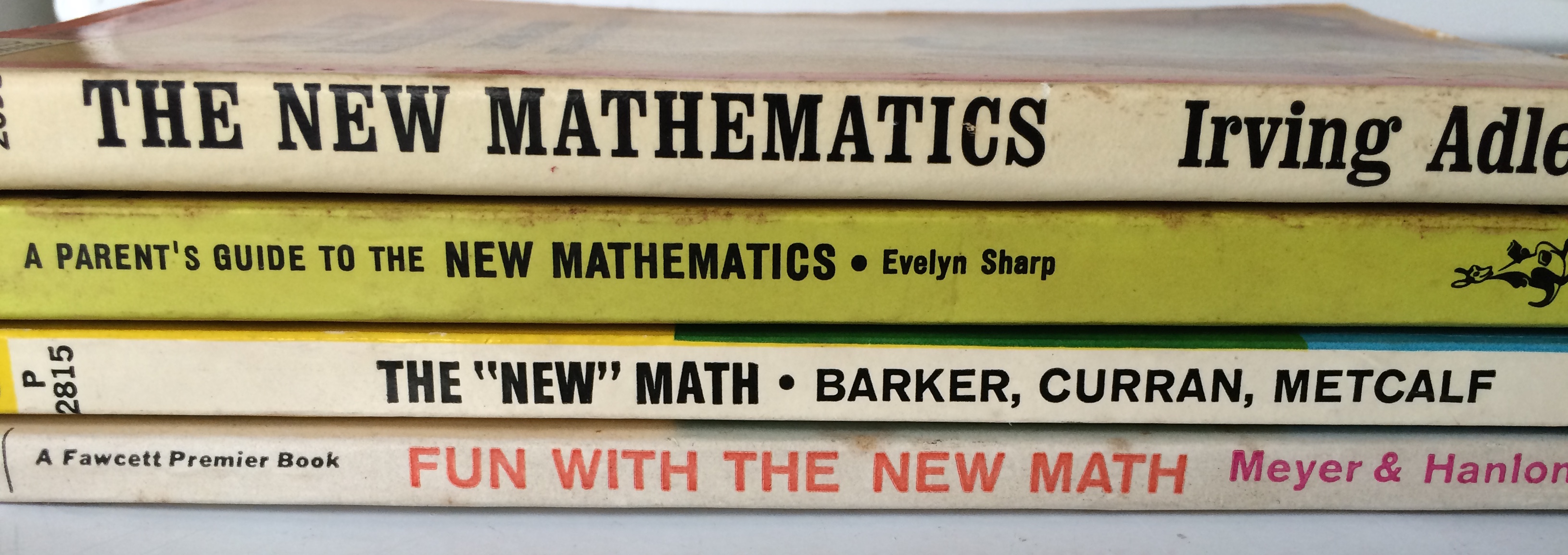
Newer than 1960 math of course...

For today's quality learning conversation (QLC) we were asked to focus on mathematics as this has been our professional development focus. Having a shared topic immediately had us all engaged and asking questions to help further our thinking. Interestingly all of our wonderings/concerns/fears were the same! So let me unpack them a bit further in my context.

1) When trying something new there is always uncertainty about whether you are doing the "right" thing. There is also the added pressure of external reporting. What exactly does assessment look like when you totally flip the way you are teaching? What does that look like when planning? Are we using the right assessments?

2) What does the structure of the lesson look like now? What does the week look like? How on earth do you fit everything in?

3) How do I ensure I am meeting the needs of all my learners? How do I know that the quiet ones (less vocal) are learning? How do I spread myself to be in more than one place at once?

So these are the questions I am asking at the moment and it seems that everyone else is asking these too. From our conversation I have decided to focus on a couple of things:


  • If we value this new way of teaching maths how do we show that we value it in our reports? I need to be gathering some anecdotal notes about the way that students are collaborating, participating, discussing and risk-taking.
  • I need to focus on the above things as positive outcomes and trust that this will be reflected in summative assessment later in the year. I have already seen huge changes in the way that students are approaching maths tasks and I really value the culture of being able to take risks, challenge and value each others thinking and learning.
  • Talking chips (thanks Kelly!) could be a way to increase participation of those who are being quieter and/or make those with a lot to say to hold back a little to allow the quieter ones to have a chance.
  • Perhaps the planning cycle looks different for all levels/contexts. I am thinking that once my Stage 7/8 learners have truly explored fractions, decimals and ratios then the rest of the year will be full of rich open tasks that weave in their learning with the strands. I look forward to the possibilities!
I have absolutely LOVED the mathematics PD that we have had so far and totally believe in it's value. Like any new thing it will take time to implement and feel comfortable with but it is incredibly awesome to have the freedom and flexibility to take those risks and try things out.